

Download the Course Brochure Link
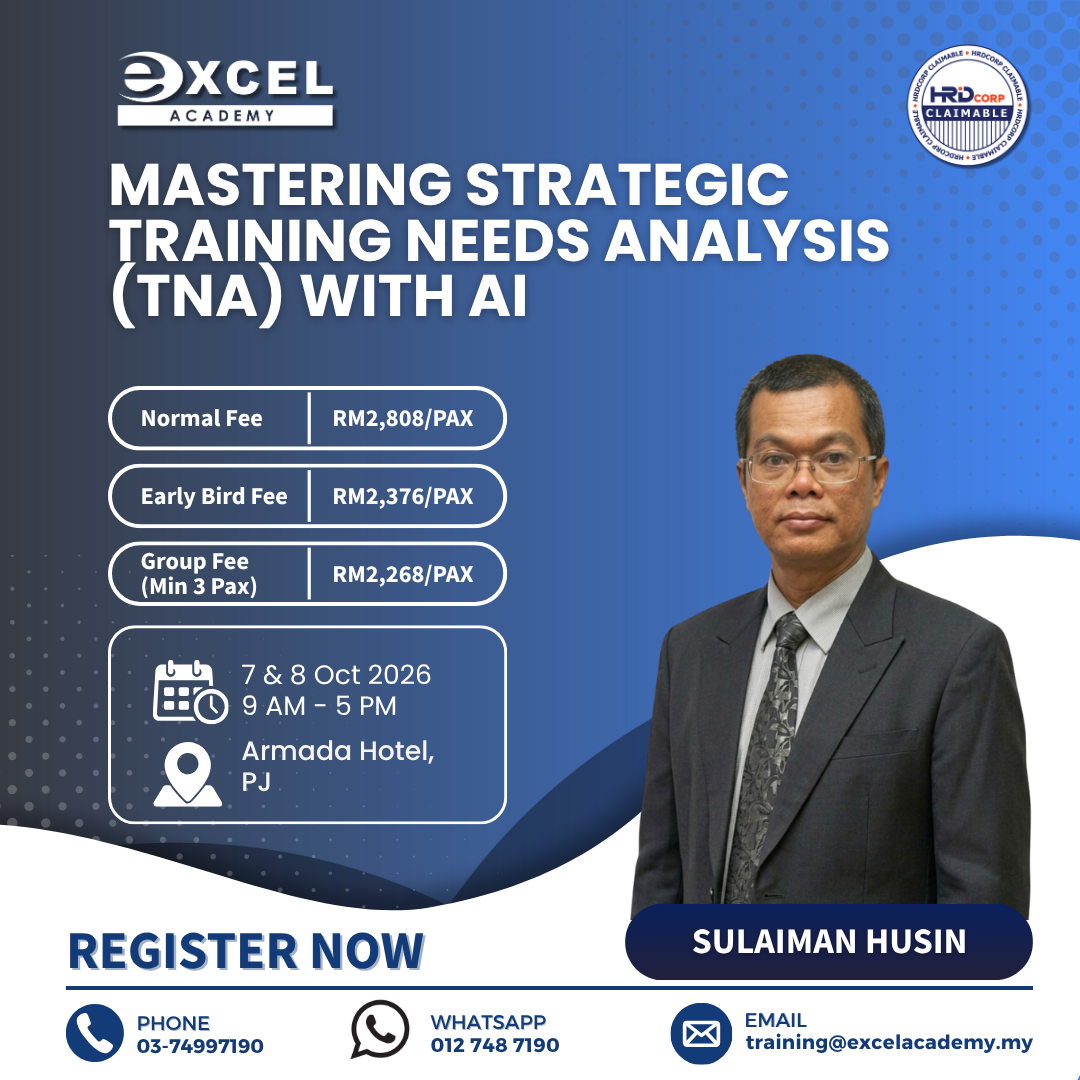
This two-day intensive programme equips HR, Learning & Development, Organisational Development, and people managers with a structured and evidence-based approach to identifying genuine training needs and translating them into practical development priorities. Rather than building training plans around requests, available budgets, or assumptions, participants will learn how to connect workforce development directly to business challenges, competency gaps, performance evidence, and organisational strategy.
With Claude or ChatGPT integrated throughout the TNA process, the programme demonstrates how AI can accelerate data collection, qualitative analysis, gap identification, instrument design, proposal drafting, and evaluation while maintaining human judgement, responsible data handling, and appropriate validation. Participants will also learn how to distinguish genuine training needs from performance issues that may require process, management, systems, or employment-related interventions instead.
Through hands-on workshops, case studies, live AI demonstrations, team exercises, and practical organisational scenarios, participants will work through the complete TNA cycle from defining the business problem and gathering evidence to prioritising competency gaps, developing training solutions, building the business case, and establishing measurement and ROI frameworks. By the end of the programme, participants will leave with practical templates, AI prompting techniques, and an actionable TNA approach that can be applied to annual training planning and workforce development initiatives.
What will you learn in Mastering Strategic Training Needs Analysis (TNA) with AI?
- Understand the full Training Needs Analysis process and its role in organisational development.
- Identify training needs at organisational, departmental/task, and individual levels.
- Use KPIs, performance data, audit findings, feedback, and other evidence to identify competency gaps.
- Distinguish genuine training needs from issues caused by motivation, systems, processes, or supervision.
- Use Claude or ChatGPT to support surveys, interviews, analysis, summarisation, and report drafting.
- Design suitable data collection methods such as surveys, interviews, focus groups, observations, and document reviews.
- Prioritise training needs based on business impact, risk, urgency, cost, and feasibility.
- Develop suitable training solutions and prepare stronger training proposals and business cases.
- Measure training effectiveness using evaluation frameworks, KPIs, baselines, and ROI considerations.
- Create practical implementation plans with clear actions, owners, and timelines.
Course Outline
Module 1: TNA Fundamentals and Strategic Context
– Understand what a genuine training need is and how it differs from a request or preference.
– Learn the complete TNA process from analysis and prioritisation to delivery and evaluation.
– Identify training needs at organisational, task, and individual levels and link them to business priorities.
Module 2: Organisational and Departmental Challenge Mapping
– Identify key organisational and departmental challenges that may affect performance.
– Map business challenges to possible competency and development gaps.
– Determine whether training is the appropriate response before recommending a programme.
Module 3: Introduction to AI Tools in TNA
– Explore how Claude or ChatGPT can support drafting, translation, summarisation, and analysis.
– Learn effective prompting techniques to produce more useful and relevant AI outputs.
– Understand AI limitations, human verification, data protection, and responsible use of employee information.
Module 4: AI-Powered Data Collection
– Select suitable data collection methods such as surveys, interviews, focus groups, and observations.
– Design clear and effective questions that capture useful information about capability gaps.
– Use Claude or ChatGPT to help develop, test, and improve data collection instruments.
Module 5: AI-Enhanced Data Analysis and Gap Analysis
– Analyse quantitative and qualitative evidence to identify competency gaps.
– Distinguish training needs from issues related to motivation, processes, systems, or supervision.
– Prioritise development needs based on business impact, risk, urgency, cost, and feasibility.
Module 6: Developing Training Solutions and the Business Case
– Select suitable interventions such as classroom training, coaching, digital learning, or blended learning.
– Develop clear learning objectives, training recommendations, and estimated programme costs.
– Use Claude or ChatGPT to support the preparation and improvement of training proposals and business cases.
Module 7: Measurement and Evaluation Framework
– Understand how to measure reaction, learning, behaviour, and business results.
– Establish baselines, KPIs, and follow-up measures before training is delivered.
– Explore ROI measurement and use AI to assist with evaluation reporting and analysis.
Module 8: Group Project, Action Planning and Implementation
– Present TNA findings covering the business challenge, competency gap, recommendation, and measurement plan.
– Convert recommendations into an implementation plan with clear owners, timelines, and responsibilities.
– Develop practical next steps and a 30-day action plan to apply the TNA process in the workplace.