

Download The Course Brochure Link
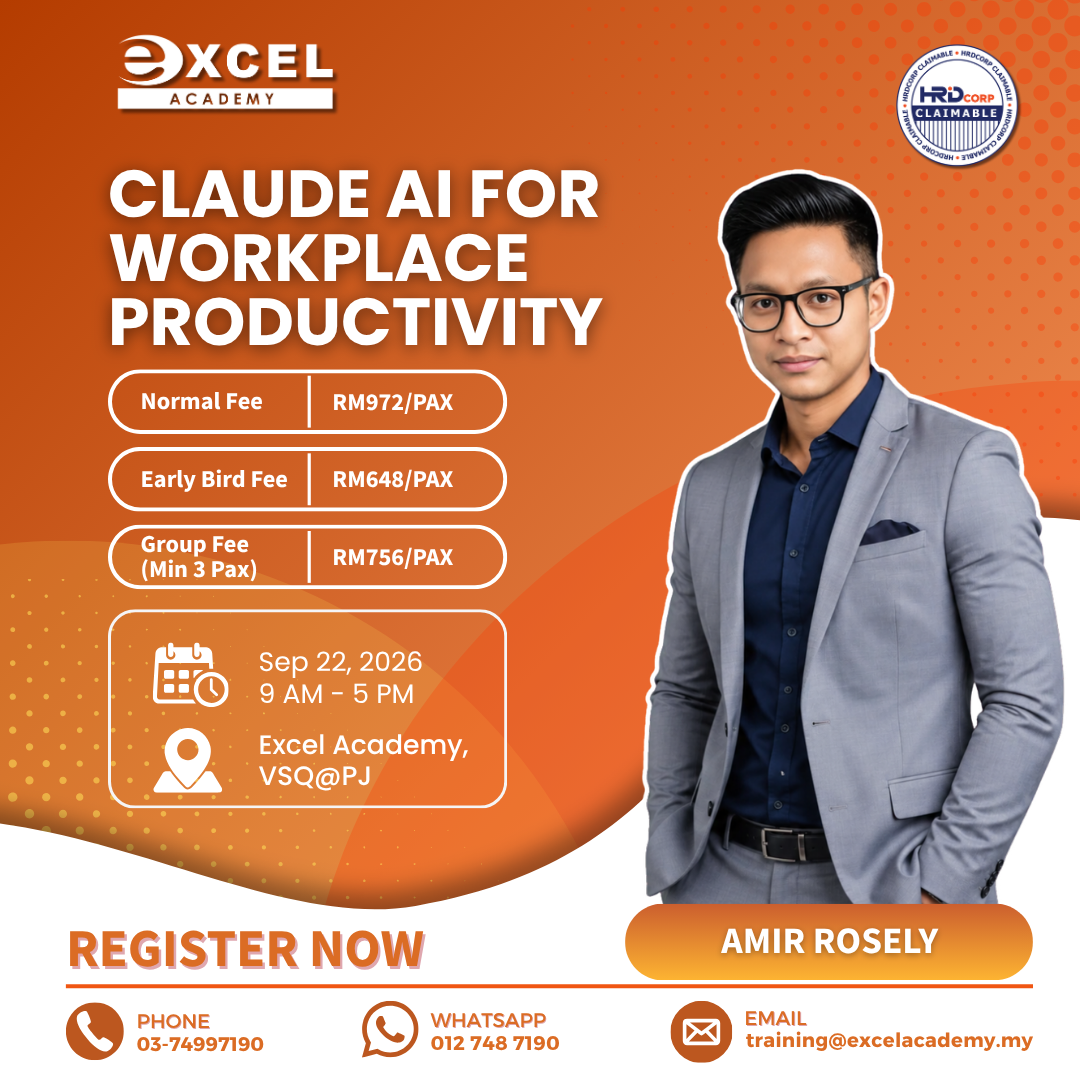
Claude AI for Workplace Productivity is a one-day interactive programme designed to help professionals use Claude as a practical thinking partner for writing, research, analysis, planning and everyday workplace tasks.
Rather than focusing only on basic chatbot use, this hands-on training explores higher-value Claude features such as Projects, Artifacts, Skills, web search and file analysis. Participants will learn how to organise ongoing work, analyse documents and data, create structured outputs and develop repeatable AI-assisted workflows.
Through live demonstrations, guided practice and workplace scenarios, participants will gain practical experience turning raw information into reports, dashboards, checklists and other stakeholder-ready outputs. By the end of this training, participants will be able to build a simple and structured Claude workflow that supports greater efficiency and productivity.
What will you learn in this Claude AI for Workplace Productivity?
- Write structured Claude prompts using clear context, task instructions, source material, output form at, and review criteria.
- Identify suitable workplace tasks for Claude assistance while applying privacy, accuracy and human review considerations.
- Organize ongoing work using Projects, reference materials, project instructions and relevant memory or past-chat context.
- Use Artifacts to create, review, and iterate structured outputs such as documents, diagrams, checklists, dashboards, or simple interactive tools.
- Apply Claude to analyze uploaded documents, spreadsheets, images, or notes and convert findings into practical recommendations.
- Use web search, Skills, and connectors appropriately to support source-grounded research and repeatable workplace workflows.
Why Attend This Claude AI for Workplace Productivity Training?
Claude AI for Workplace Productivity is designed for professionals who want to move beyond occasional AI use and develop a more structured approach to working with Claude.
Participants will explore practical ways to use Claude for everyday workplace activities such as reviewing documents, organising information, drafting professional content, conducting research and transforming data or notes into clearer outputs. The programme emphasises repeatable workflows that can be applied across different roles and departments.
The training also introduces responsible AI practices, including privacy awareness, fact-checking, reviewing source information and maintaining human oversight of AI-generated outputs. These practices are especially important when Claude is used to support business decisions or stakeholder communications.
Who Should Attend?
This Claude AI for Workplace Productivity programme is suitable for executives, managers, HR professionals, administrators, marketing and sales teams, researchers and other professionals who already have some familiarity with AI tools and want to use Claude more effectively at work.
No programming knowledge is required.
Course Outline
Module 1: Claude AI Chat Fundamentals & Prompting for Work
– What Claude is and how it supports writing, thinking, learning, planning, research and work output creation
– Claude interface overview: chat, file upload, image input, voice/mobile/desktop access
– Prompting framework: role, context, task, source, format, constraints, examples and quality review criteria
– Responsible AI habits: privacy, sensitive information, hallucination checks, citation review and human accountability
Module 2: Projects, Memory & Knowledge Management
– Using Projects to organize conversations, instructions, documents and recurring work by topic or department
– Setting project instructions for tone, role, output style, workflow rules and preferred formats
– Understanding Memory and past-chat search for continuity and reduced repetition
– Designing project workspaces for HR, marketing, training, sales, administration, research or management tasks
Module 3: Artifacts, File Analysis & Visual Output
– Using Artifacts to create and refine documents, checklists, diagrams, tables, dashboards, website mockups and simple tools
– Uploading PDFs, Word documents, spreadsheets, CSV files, images or notes for summarization, extraction and review
– Turning complex information into clearer structures such as comparison tables, action trackers, visual summaries and briefing packs
– Reviewing Claude outputs for accuracy, completeness, tone, formatting, usability and stakeholder readiness
Module 4: Skills, Web Search, Connectors & Workflow Automation
– Understanding Claude Skills as task-specific instructions, resources and workflows for more reliable specialized outputs
– Using web search for up-to-date information, source-grounded answers, citation checking and research briefings
– Understanding connectors for approved integration with tools such as Google Drive, Gmail, Microsoft 365, Slack or other workplace systems, where available
– Designing a reusable Claude workflow from research to draft, analysis, artifact creation, review and final output
For more information about our training programmes, visit Excel Academy Malaysia.